

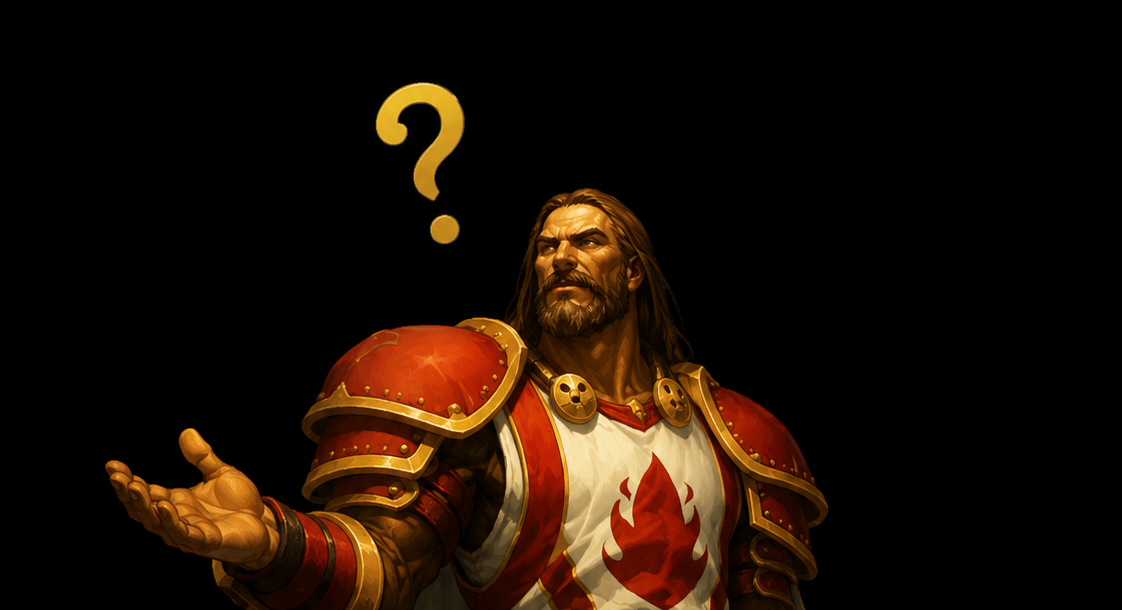
The Scarlet Crusade started as a genuinely noble idea — Silver Hand survivors banding together to fight the Scourge after Arthas Menethil’s rampage through Lordaeron — and curdled into one of Warcraft’s most infamous cautionary tales about fanaticism. A demon possessed their leader from within, engineered the murder of the one man who might have kept them honest, and the organization spent years afterward burning “corruption” out of villages that were often just… villages.
We made a short on this exact question — go watch it, then stick around, because there’s a lot more going on under the surface than 60 seconds can hold.
They Started as the Good Guys
Here’s the part that gets lost once people remember the Scarlet Crusade mainly as “the guys who burn everything, including children.” The founders who would go on to shape the Crusade actually met in Southshore during the Third War — survivors of the Order of the Silver Hand, regrouping after Arthas slaughtered his way through Lordaeron and murdered his own father and Uther the Lightbringer along the way. Together, they purified a corrupted dark crystal into what would become the Ashbringer, one of the most iconic weapons in the entire franchise.
Taelan Fordring offered his family’s untouched keep, Hearthglen, as their base. Their ranks swelled with people who’d lost everything to the Scourge — the kind of grief that makes “kill every undead thing in Lordaeron” sound less like extremism and more like the only reasonable response left.
There’s a retcon worth knowing here: modern Blizzard lore states that Alexandros Mograine — the actual wielder of the Ashbringer — technically never joined the Scarlet Crusade itself. He fought alongside its founders and is closely associated with the organization in most players’ minds, but the “Scarlet Crusade” as a formal entity is, by current lore, a separate and later development from what he was part of.
The Betrayal That Broke Everything
The turning point isn’t a slow ideological slide. It’s a specific, deliberate act of sabotage. During an assault on Stratholme, Saidan Dathrohan — one of the group’s key leaders — was killed and his body possessed by the dreadlord Balnazzar. From that point forward, “Saidan Dathrohan” wasn’t a person anymore. He was a demon wearing a trusted leader’s face, quietly steering the entire organization from the inside.
Balnazzar and his brother Varimathras saw Alexandros Mograine and the Ashbringer as a real threat to their plans. So Balnazzar struck a deal with Kel’Thuzad: kill Mograine, and the Scourge loses one of its most dangerous enemies. The method Balnazzar chose is the genuinely tragic part — he spent time cultivating Mograine’s own son, Renault, playing on the kid’s hunger for approval until Renault agreed to lead his father and High Inquisitor Fairbanks straight into a Scourge ambush in Stratholme. Alexandros Mograine died at the Scourge’s hands, but it was his own son who opened the door.
The Descent Into Fanaticism
With Mograine gone and “Dathrohan” secretly a demon, the Crusade’s moral center didn’t just weaken — it evaporated. Balnazzar spent years quietly poisoning the organization’s leadership with paranoia and rage, and High Inquisitor Sally Whitemane, grieving and furious, proved a willing student. She and Renault Mograine turned the Scarlet Monastery into a torture pit. Interrogations of anyone “deemed a threat” became routine.
This is the era that defines how most players actually remember the Crusade: patrols sweeping through Lordaeron villages, “purifying” anyone suspected of plague corruption, regardless of whether that suspicion held up to any real scrutiny. High General Abbendis died defending Hearthglen from the undead, saved at the last moment by Whitemane’s reinforcements from the Monastery — which only cemented Whitemane’s rise as the Crusade’s central, enduring figure. By the time Renault’s younger brother Darion finally confronted him over what he’d done, a shadow of Alexandros Mograine himself is said to have risen from the Ashbringer and struck Renault down for his betrayal.
Balnazzar’s plan, as much as he had one beyond simple chaos, seems to have worked. The Crusade grew paranoid, brutal, and increasingly isolated — making enemies of nearly everyone, including the very people they were supposedly protecting.
Where You’ll Actually Meet Them
If you’ve leveled a character through Classic content, you’ve already walked through Scarlet Crusade territory without necessarily clocking the full story behind it. The Scarlet Monastery — split into four distinct wings, Graveyard, Library, Armory, and Cathedral — is one of Classic’s most iconic dungeon stops, and both Whitemane and a corrupted, risen version of Mograine himself show up as bosses there. We cover the complete boss breakdown, mechanics, and loot for all four wings in our full Scarlet Monastery guide.
Why the Story Still Works
What makes the Scarlet Crusade genuinely great writing, twenty-plus years later, isn’t that they’re villains. It’s that almost nobody in the story is lying to themselves about their own righteousness. Whitemane isn’t a cartoon fanatic — she’s someone who watched everyone she loved die and die again as undead, and found a demon-poisoned organization that gave her rage somewhere to go. That’s a much more unsettling story than “evil cult was evil the whole time,” and it’s exactly why this faction still gets brought up in lore discussions two decades after Vanilla launched.
Related Guides
- Scarlet Monastery Guide (WoW Classic) — every boss, mechanic, and loot table across all four wings
- Scarlet Monastery Quests Guide (WoW Classic) — the faction specific quests built around defeating Mograine and Whitemane
Sources: Blizzard Watch — Know Your Lore: High Inquisitor Sally Whitemane, Warcraft Wiki — Scarlet Crusade, Wowpedia — Saidan Dathrohan, Wowpedia — Renault Mograine.