

Quick answer: Yes. More than two decades after launch, World of Warcraft remains the most-played subscription MMORPG on the planet. The most credible subscriber estimate — around 7.25 million as of early 2024 — comes from a chart Blizzard itself presented at GDC 2024, independently confirmed by GameSpot, TechSpot, and IGN. The 2026 expansion, Midnight, produced a genuine, verified Twitch viewership surge at launch. And the “WoW is dying” narrative that dominated headlines around 2021 hasn’t matched reality since Dragonflight reversed the trend in 2022.
Quick heads up before we get into it: while researching this piece, I ran a bunch of the “WoW statistics” claims floating around the internet through an actual fact-check, and a lot of them didn’t survive contact with their supposed sources. I’ve pulled the receipts on that into its own article, because the investigation deserved its own space rather than a paragraph buried in the middle of this one. This piece sticks to what I could actually verify.
What I Can Actually Confirm About WoW’s Subscriber Count
Blizzard hasn’t published an official subscriber count since 2015, when it confirmed 5.5 million. The most credible number since then comes from a chart Blizzard’s own Warcraft franchise general manager, John Hight, presented during a GDC 2024 talk reflecting on the franchise’s history. YouTuber Bellular Warcraft analyzed that chart pixel by pixel, cross-referenced it against Activision Blizzard’s earlier earnings statements, and landed on roughly 7.25 million subscribers in Q1 2024. That’s not just a YouTube guess floating in the void, either — it was independently reported by GameSpot and TechSpot, and Dexerto separately confirmed that IGN’s March 2024 reporting independently landed on “over 7 million” too. Three separate legitimate outlets, all pointing at the same neighborhood of numbers. That’s about as good as this genre of data ever gets.
The shape of that recovery is genuinely interesting, too, not just the endpoint. Bellular’s chart analysis traces subscribers dipping under Legion’s aftermath into the Shadowlands trough, then climbing back through Dragonflight — and what’s unusual isn’t just that it climbed, it’s when. Normally a WoW expansion spikes hard at launch and bleeds subscribers steadily until the next one. Dragonflight broke that shape; numbers kept growing between patches instead of only at launch.
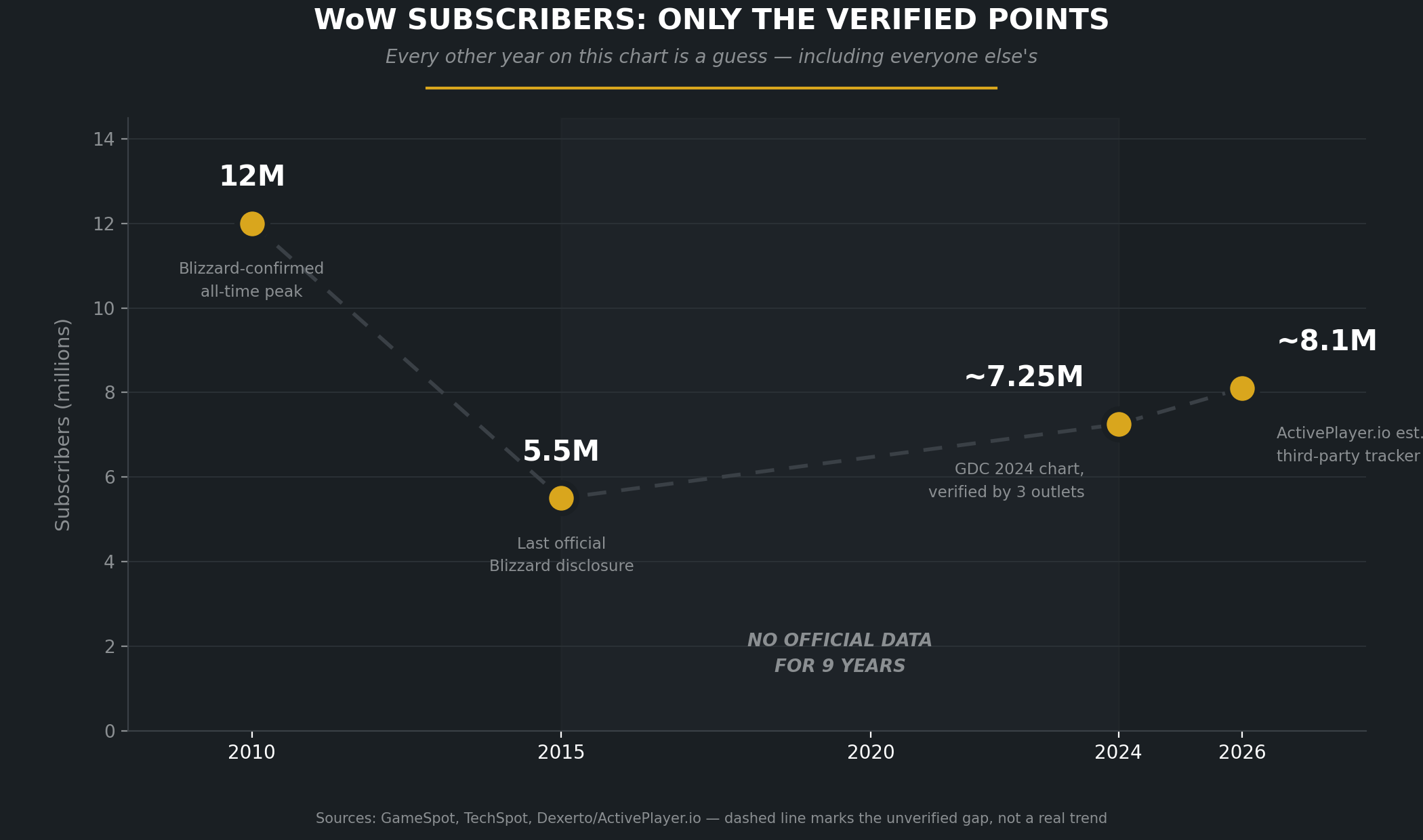
As for right now: Dexerto’s July 2026 tracker cites ActivePlayer.io’s estimate of roughly 8.1 million average monthly players, plus a peak of 212,076 concurrent players logged via PlayerAuctions in June 2026. Even Dexerto’s own writers add the caveat you’d expect — Blizzard only discloses numbers through quarterly earnings calls, folded into a combined Activision Blizzard total, so treat any tracker estimate “with a pinch of salt.” I’ll pile on one more wrinkle myself: PlayerAuctions is a player-to-player account and gold marketplace, so I’m treating its number as one data point among several, not gospel.
For context on just how far WoW has climbed back: its all-time peak was roughly 12 million subscribers in 2010, during Wrath of the Lich King, a number Blizzard actually confirmed at the time.
Midnight’s Launch Was a Real, Verified Twitch Moment
WoW’s 11th expansion, Midnight, launched globally on March 2, 2026 (early access from February 26), as the second chapter of the Worldsoul Saga that kicked off with The War Within in 2024. Metacritic has it at a “generally favorable” 82 based on 28 critic reviews, and OpenCritic puts it at 85% critic recommendation across 27 reviews — solid, if not universally rapturous. Players have been a bit more split: the Metacritic user score sits noticeably lower than the critic score, and reviews written a few months out consistently mention a rocky post-launch patch cycle alongside real love for the long-awaited player housing system.
Here’s the part I actually got to verify with hard numbers instead of vibes: the Twitch impact, straight from StreamsCharts, an actual industry-standard Twitch analytics service, not some blog’s secondhand summary of one. Midnight’s early access weekend pulled 6.7 million hours watched, a 112% jump over the prior period, peaking at 249,300 concurrent viewers on the night of February 26. That put WoW in 4th place among every Twitch game category that weekend, behind only Resident Evil: Requiem, GTA V, and League of Legends (which had a packed esports schedule working in its favor). And if you’re wondering who carried that weekend on their back: Asmongold, who alone racked up over 487,400 hours watched and peaked at 59,101 concurrent viewers.
The “WoW Is Dying” Myth, Fact-Checked
The “WoW is dying” meme has been around since roughly 2010, when subscriptions peaked above 12 million and then genuinely, painfully declined through Cataclysm and Warlords of Draenor. That part’s real — it’s where the meme comes from, and it earned it. Even Blizzard’s own John Hight admitted in his GDC 2024 talk that Shadowlands specifically caused “historically high churn,” with the game losing an estimated 3+ million subscribers between that expansion’s launch and its low point.
But the discourse froze in amber right around that Shadowlands slump, and it never updated. What it’s missing: Dragonflight (2022) actually broke the usual boom-bust pattern — subscribers grew between content patches instead of only spiking at launch and bleeding out, a pattern Blizzard credited to a faster, more consistent content cadence. That recovery kept going through The War Within (2024) and now Midnight (2026), based on everything above that I could actually stand behind.
How Does WoW Stack Up Against Other MMOs?
WoW is still the biggest subscription MMORPG out there by a wide margin, and its most talked-about rival is Final Fantasy XIV. I’m going to resist the urge to throw out a specific “lifetime registered accounts” number for FFXIV here — I couldn’t trace any single figure back to something official, so I’m not going to pretend otherwise just because it would round the article out nicely. What I can say with confidence: WoW’s competitive scene is genuinely alive, with both the Mythic Dungeon International (MDI) and Arena World Championship (AWC) circuits still running as of 2026. Old School RuneScape and Elder Scrolls Online both have loyal, healthy communities too, but neither is playing in WoW’s weight class on subscriber scale.
My Actual Verdict
WoW in 2026 isn’t the cultural phenomenon it was during Wrath’s peak in 2010, and it doesn’t need to be to be doing well. The subscriber trend that actually traces back to real sources — that GDC 2024 chart, corroborated independently by GameSpot, TechSpot, and IGN — shows genuine recovery from the Shadowlands low point. Midnight’s Twitch numbers, verified straight from StreamsCharts, show a real, measurable audience showing up at launch. The “dying” narrative was true once, roughly 2010 to 2021. The verifiable stuff from 2022 onward tells a consistent story of recovery.
If you want the deeper dive into which “WoW statistics” articles you should actually trust — and which ones I caught making things up entirely — that’s the companion piece linked above. This one, I promise, is just the parts I could stand behind myself.
Note: Blizzard/Activision has not published official WoW-specific subscriber or revenue figures since 2015; even post-Microsoft-acquisition earnings reports only disclose combined Activision Blizzard segment totals. All player figures above are third-party estimates and should be treated accordingly.